
Complaint, Case and Court Management System
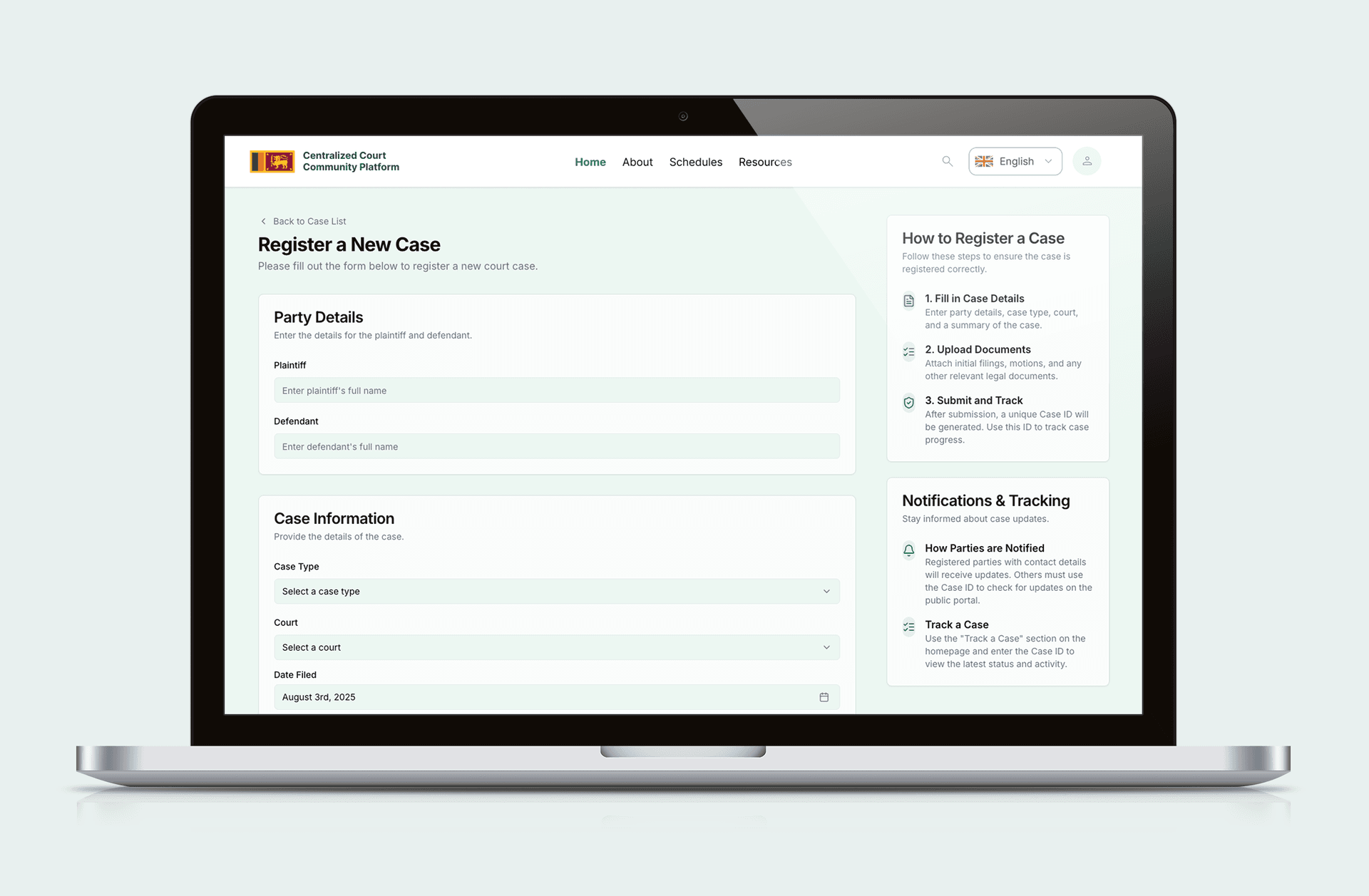
A comprehensive system to digitize and streamline court proceedings, from case filing and scheduling, to verdict delivery and records management.
Understanding the Justice System's Users
Research involved observing court proceedings, and conducting deep-dive interviews with judges, lawyers, clerks, and citizens to map the entire judicial process and its pain points.
Research Methodology
Conducted process analysis, stakeholder workshops, and ethnographic studies within courtrooms. The goal was to build a holistic view of the operational, legal, and human challenges of the current system.
Defining the Core Problem
The judiciary's reliance on manual, paper-based systems creates massive inefficiencies, limits access to justice, and prevents data-driven governance. A digital transformation was necessary.
Problem Statement
The judicial process is crippled by administrative bottlenecks, from slow case filing and chaotic scheduling to insecure document handling. This lack of a unified digital infrastructure erodes public trust and delays justice, impacting lawyers, judges, and citizens alike.
User Personas
The Judge
"I need my entire case docket for the day available digitally, with all relevant files and evidence accessible with a single click."
The Lawyer
"I need to file new cases online, submit evidence securely, and receive immediate updates on hearing schedules."
The Court Administrator
"My job is to manage the court's calendar and resources. I need a tool that automates scheduling and prevents conflicts."
The Citizen (Litigant)
"I just want to know what's happening with my case without having to travel to the courthouse."
Key Pain Points
Overwhelming Paperwork & Manual Processes
Courts were drowning in physical case files, leading to storage issues, difficult document retrieval, and frequent misfiling.
Inefficient Case Scheduling & Delays
Manual scheduling led to frequent conflicts, case backlogs, and long waiting periods for hearings, frustrating all parties involved.
Lack of Transparency for Litigants
Lawyers and citizens had no easy way to check case status, hearing dates, or access court documents, requiring physical visits.
Data Silos & Poor Reporting
Information was scattered across various systems and records, making it impossible to generate analytics on court performance or case trends.
Judicial Process Flow Architecture
I designed the system's architecture to mirror the entire lifecycle of a case, from initial filing and evidence submission to scheduling, hearings, and final verdict.
Designing Digital Justice
The solution was envisioned as a modular, secure platform with distinct interfaces for each user persona, ensuring a focused and efficient experience for all.
Key Design Decisions
Ideation focused on security, efficiency, and transparency.
- • **E-Filing Portal:** A public-facing portal for lawyers to file cases and submit documents 24/7.
- • **Judge's Digital Bench:** A tablet-friendly interface for judges to manage their docket, review cases, and sign orders digitally.
- • **Automated Calendaring:** An intelligent scheduling module that avoids conflicts and optimizes courtroom utilization.
Building and Validating
High-fidelity, interactive prototypes for each module were built and rigorously tested with judges, lawyers, and court staff to ensure usability and security.
Prototype Highlights
Prototypes simulated the end-to-end flow, from a lawyer filing a new case to a judge reviewing it on their digital bench during a hearing.
Usability Study Results
Round 1 (Judges & Lawyers)
- Users require a powerful but simple search function to find case files instantly.
- The calendaring feature needs to clearly show conflicts and availability.
Round 2 (Admin Staff & Litigants)
- The digital case filing process must be intuitive with clear instructions to reduce errors.
- Mobile access for checking case status is a high-priority feature for litigants.
- Automated notifications for hearing dates and document submissions are critical.
- Admin staff need a dashboard to monitor daily dockets and staff workload.
Impact & Results
Project Impact
The system drastically cut case processing times, reduced administrative errors, and provided unprecedented transparency. The pilot implementation led to a significant reduction in case backlogs and increased public trust in the judicial system.
Key Learnings
Transforming a centuries-old, paper-based institution requires deep empathy and a phased approach. The success hinged on designing a system that respected existing legal protocols while introducing modern efficiencies.
Key Metrics & Impact
Next Steps
Public Portal Launch
Develop and launch a public-facing portal for citizens to track their case status and access public records.
Integration with Police Records
Integrate with law enforcement databases to automatically pull in First Information Reports (FIRs) and other relevant documents.
AI-Powered Analytics
Implement machine learning models to analyze case data for predicting case duration and identifying judicial trends.